

A private co-operative development · Lake Elsinore, CA
Southern California's Premier Lakeview Hillside Community Awaits.
A private co-operative — 96 modern homes, built at direct wholesale cost.
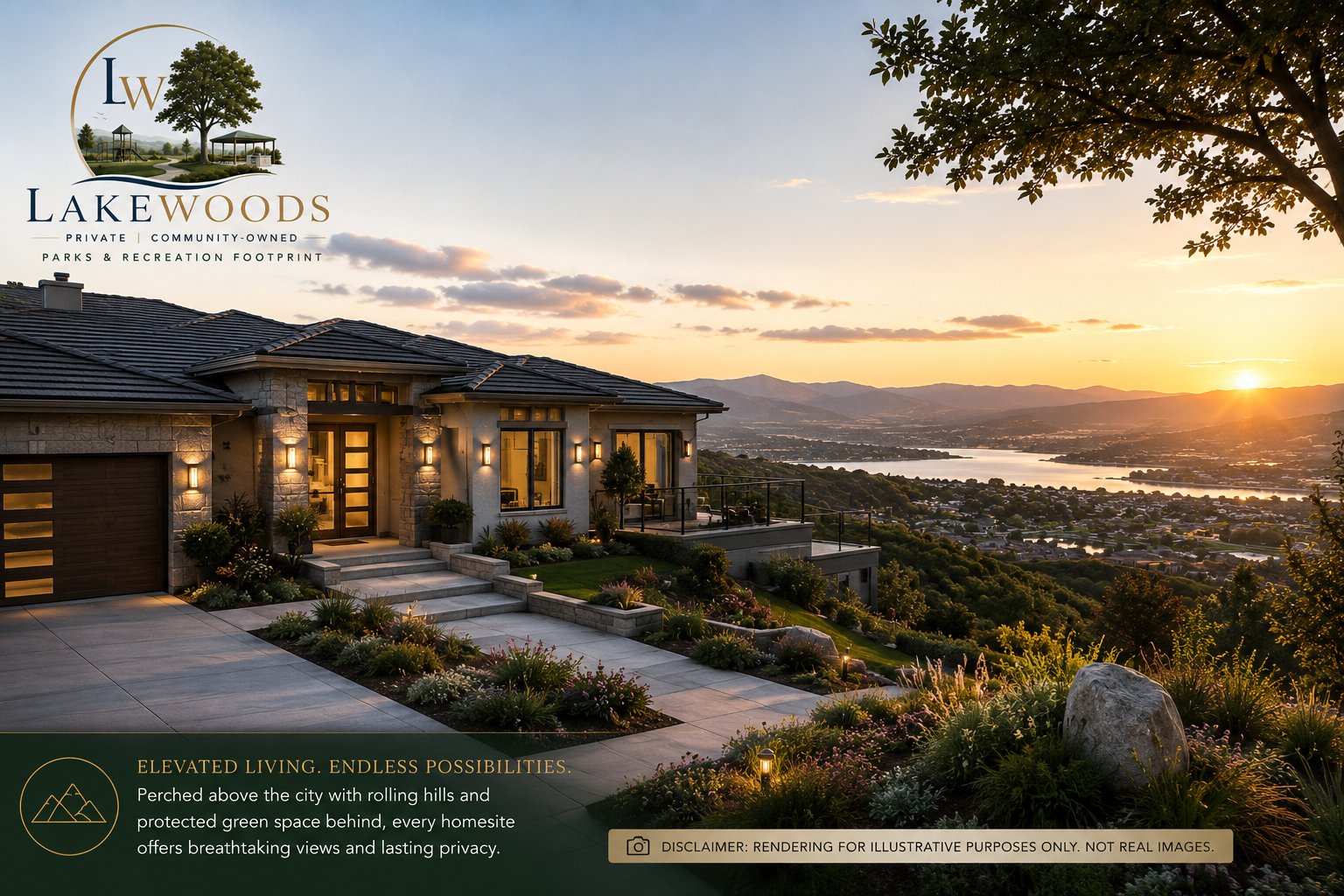
Discover premium homesites with panoramic lake views, protected open space, scenic trails, and thoughtfully planned amenities, all designed to create lasting value for generations.
The Opportunity
A new approach to homeownership and real-estate investing
Lake Woods is a private, member-owned co-operative in Lake Elsinore, Riverside County, CA. By pooling our collective capital and bypassing corporate developers, we acquire the land and build a master-planned community of 96 modern single-family homes at direct wholesale cost — on entitled land with a recorded tract map and an engineered grading plan.
- Roughly half the community permanently protected as open green space
- 96 modern single-family detached homes
- Bought at development cost — no 30–40% developer markup
- Debt-free: the group pools cash, no commercial bank interest
- Direct access off California State Route 74
De-Risked from Day One
Backed by dirt, not promises
Your Phase 1 capital isn't paying for corporate salaries or speculative marketing — it's buying a physical slice of California land. The LLC acquires the parcel outright, 100% cash and free and clear. Even if the project paused on day 91, the LLC owns a hard land asset worth millions — and you own your pro-rata share of that real dirt.
- Land bought all-cash and free & clear — no bank lien on the asset
- You hold a pro-rata deeded share of a physical asset worth millions
- If the project dissolves in due diligence, unspent capital returns to the group
- Retail buildable lot
- $200,000+
- Your co-op cost (Tier 1)
- $123,213
- Instant equity at deed
- +$75,000+
The moment the county records the Final Tract Map, you hold an individual deed with an estimated $75,000+ of built-in equity — before a single modular wall is delivered.
The Co-Operative Advantage
We eliminate the middleman
Traditional homebuilders add a 30–40% retail markup for corporate overhead, marketing, and heavy bank-financing interest. Our co-operative syndicate pools cash upfront and buys in at true development cost.
Instant built-in equity
You buy into the land and infrastructure at true development cost. The moment individual deeds are issued, your lot is worth more than your total initial cash investment.
Wholesale modular construction
State-approved, high-efficiency factory modular building — $150–$250 per square foot — saving months of construction time and eliminating weather delays.
Zero bank-debt overhead
The group pools cash upfront for land and civil engineering, so the project carries no compounding commercial bank debt — insulating members from market volatility.
More than homes. A lifetime of value.
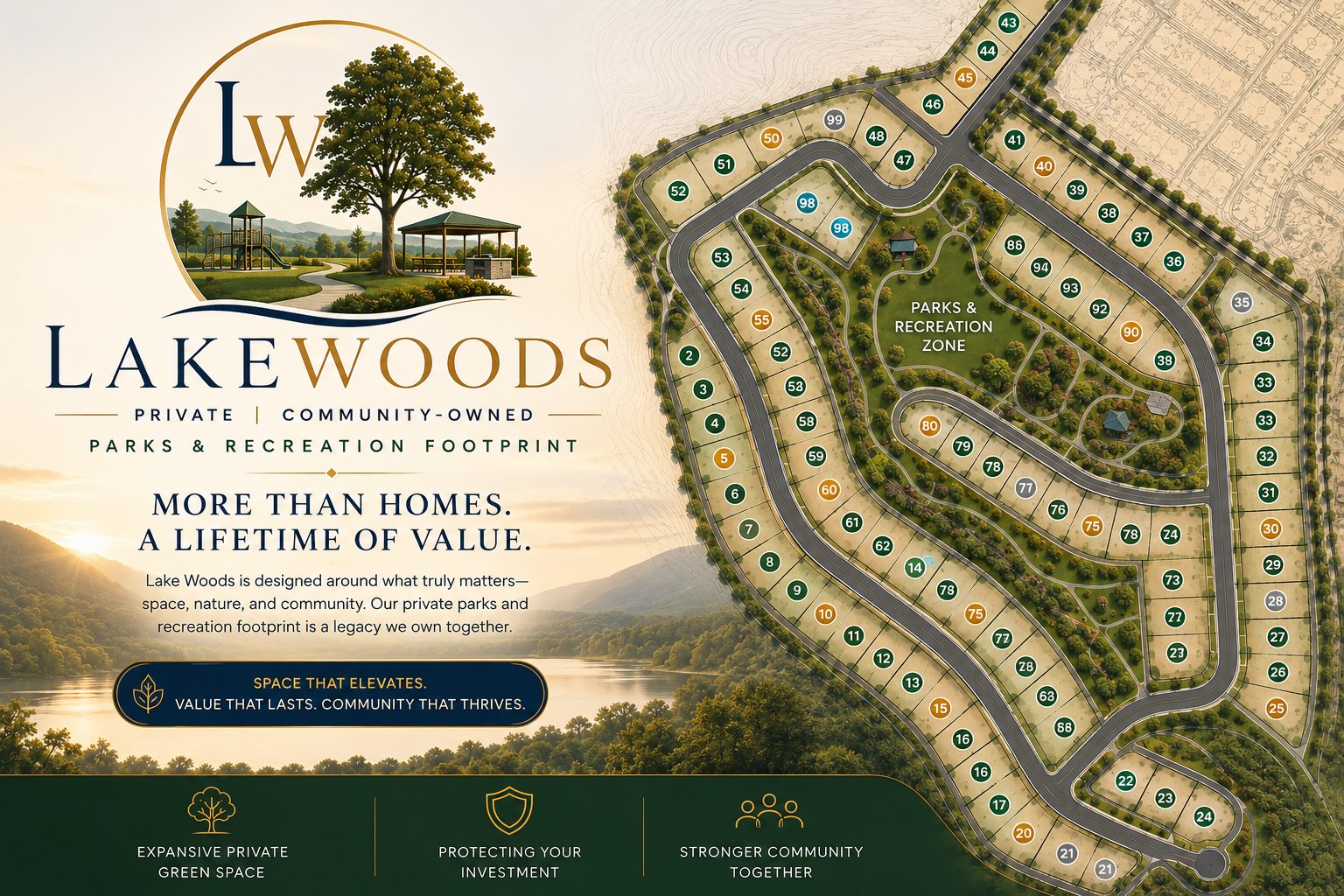
Lake Woods is designed around what truly matters — space, nature, and community. Our private parks and recreation footprint is a legacy we own together.
Space that elevates. Value that lasts. Community that thrives.
Expansive private green space
Roughly half the community is preserved as parks, trails, and open landscape.
Protecting your investment
Buying at development cost builds in equity from day one, and the permanent green buffer protects your views and value.
Stronger community together
A member-owned co-operative, transparently governed, where neighbors share both the amenities and the upside.
How It Compares
Why buy through the co-operative
| Lake Woods Co-op | Traditional New Build | Existing Resale | |
|---|---|---|---|
| How it's priced | Direct development cost | Retail + 30–40% markup | Full market price |
| Built-in equity at close | |||
| Developer / builder markup | None — member-owned | 30–40% | — |
| Bank debt in the land phase | None — pooled cash | Yes, with interest | — |
| Possible $0-cash down payment | |||
| Construction | Modular — months faster | Stick-built — weather delays | Existing home |
| Protected open green space | 50% of the community | Minimal | Varies |
| HOA parks, pool & courts | Included · $200/mo | Varies + fees | Varies |
| Development transparency · 24/7 portal | |||
| Member-owned & controlled |
Comparison reflects the Lake Woods co-operative model versus typical retail new construction and existing-home purchases; individual projects and homes vary.
Southwest Riverside County Regional Investment Matrix
Where Lake Elsinore sits among neighboring markets (2026 data).
| Metric | Lake Elsinore | Menifee | Wildomar | Murrieta | Temecula |
|---|---|---|---|---|---|
| Current median home price | $605,000 | $586,000 | $670,000 | $700,000 | $790,904 |
| Average price / SF | $285 | $299 | $312 | $315 | $384 |
| Development style | Low-cost infill, high custom margins | Corporate tracts, mass subdivisions | Ranchettes, low-density acreage | Mature suburban master-planned grids | Premium luxury tourist corridors |
| Average Mello-Roos / CFD | 🟢 Lowest — often $0 on cash infill | 🔴 Highest — up to $4,500/yr on new tracts | 🟡 Moderate — older CFDs present | 🟡 Moderate — varies by quadrant | 🟡 Moderate — established older bonds |
| Target demographic | Modern co-ops, eco/action tourists | Inbound commuters, young families | Custom builders, equestrian/ranchers | High-income families, healthcare workers | High-net-worth executives, retirees |
| Investment life-cycle tier | High-alpha growth horizon | Active expansion boomtown | Pocket infill submarket | Stabilized luxury suburb | Premium capital preservation |
The price-per-SF spread
Building via modular factory at $200/SF lands you well below the regional retail average — Wildomar $312/SF, Temecula $384/SF. That gap is a built-in equity safety net from day one.
Zero new Mello-Roos
Menifee's lower entry price rides on corporate tract bonds — up to thousands per year in permanent Mello-Roos. Our all-cash civil grid adds no new CFD, protecting long-term cash flow and resale value.
Early-cycle growth runway
Temecula and Murrieta are late-stage, built-out, and land-scarce — pushing land costs up. Lake Elsinore is in an early-to-mid transformation cycle, so the syndicate acquires land at a low wholesale entry price ahead of the sub-market's long-term appreciation.
Regional figures are estimates for comparison (2026 data); market conditions vary and are not guarantees.
Green by design
Half the community is open, living green space
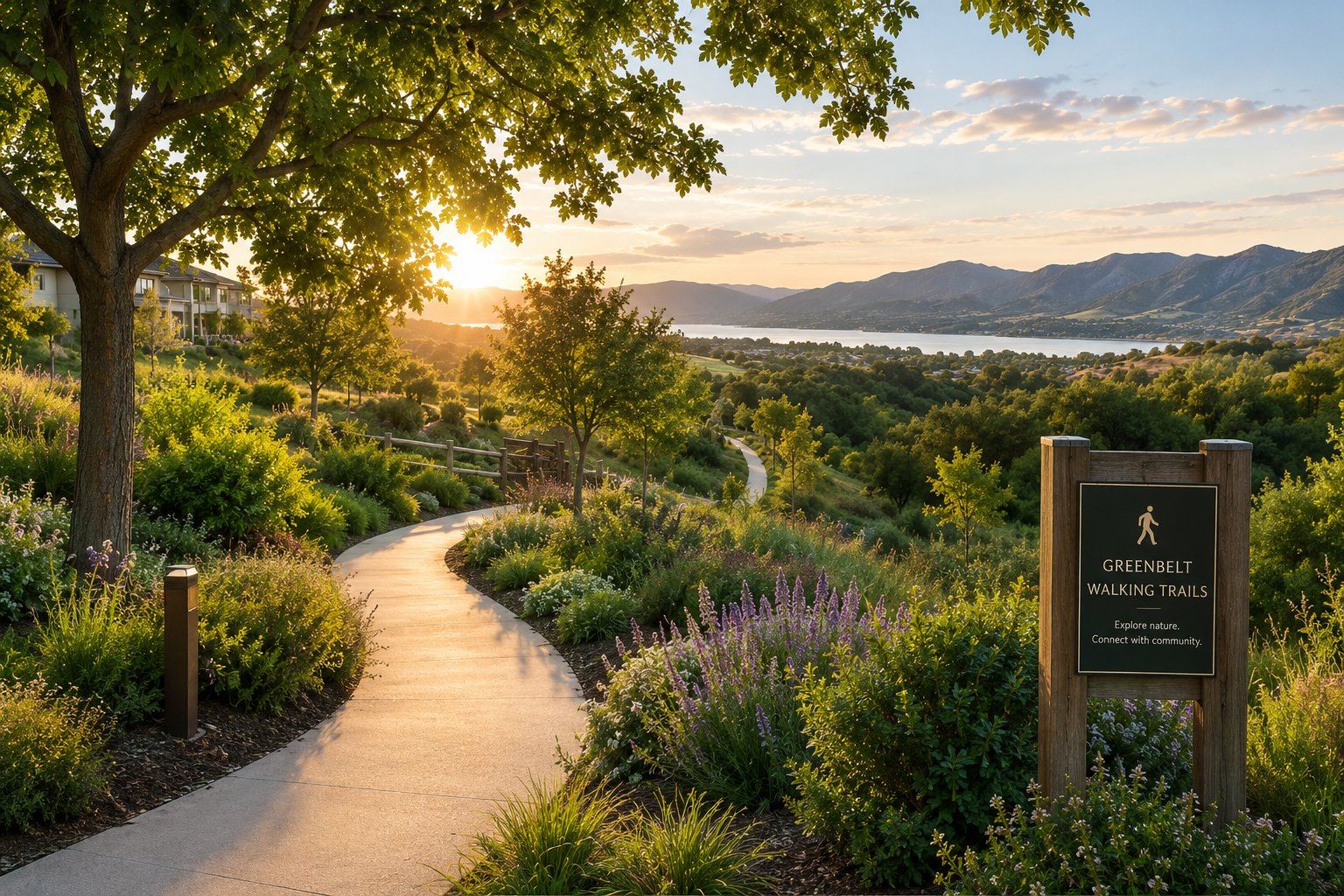
Roughly half the community is preserved as landscaped open space — walking trails, bike tracks, community vegetable gardens, and fruit-tree orchards. It's a lifestyle buyers pay a premium for and an amenity base that lifts every lot around it.
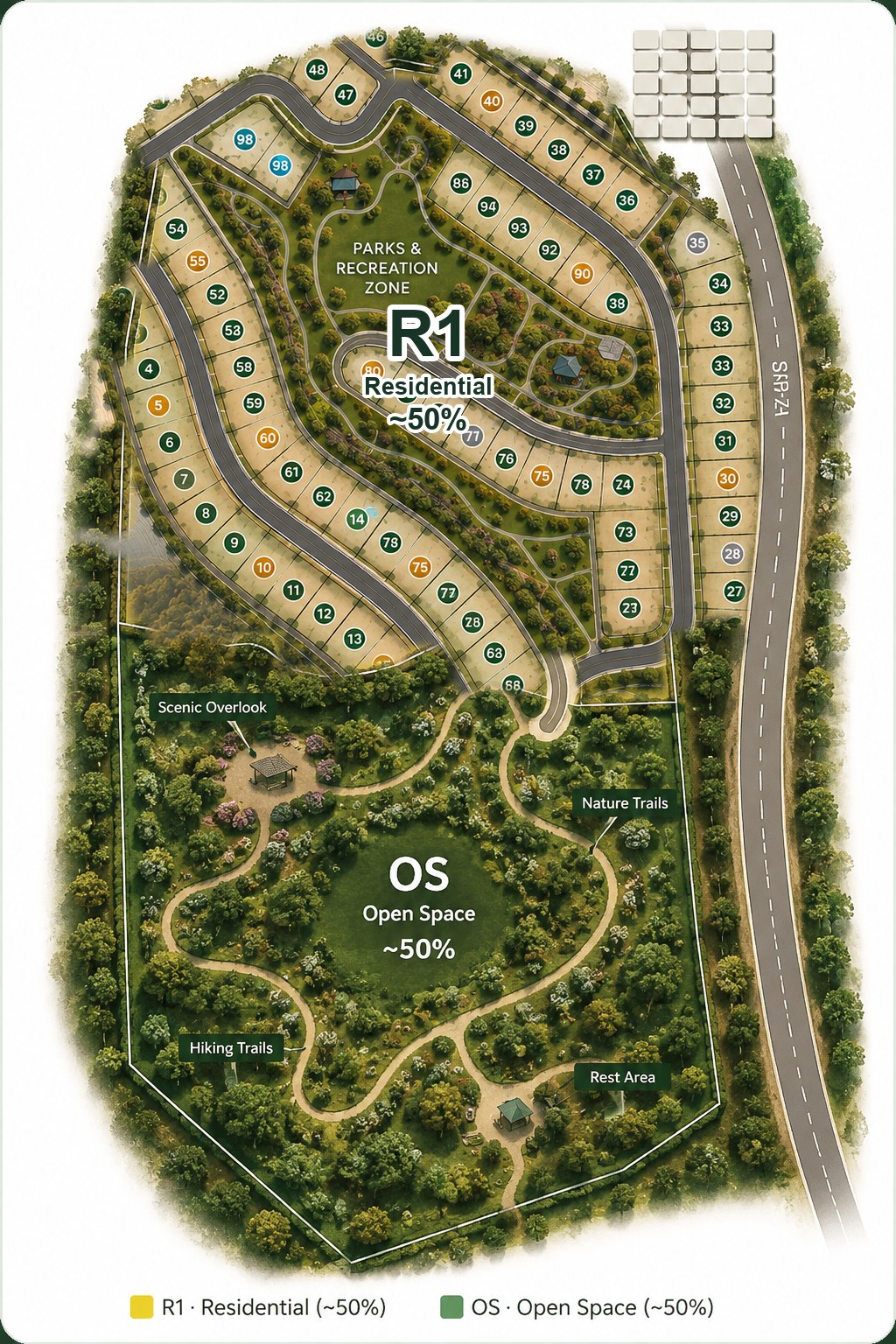
of the community stays green. The parcel splits almost evenly — an R1 residential pocket balanced by an equal share of protected OS open space — preserved as trails, gardens, orchards, and natural landscape rather than pavement, with direct frontage on State Route 74.
Walking trails
Miles of pedestrian trails weave the community together and connect every neighborhood to open space.
Bike tracks
Dedicated cycling paths for recreation and low-car connectivity across the site.
Community gardens
Shared raised-bed gardens where residents grow their own vegetables and herbs.
Fruit-tree orchards
Planted orchards bring seasonal fruit — and lasting value — to the community's common land.
Protected greenery
Roughly half the community is permanently protected as landscaped open space and natural buffer.
Shade tree canopy
Mature shade trees line the streets and open space — cooling the neighborhood and framing every home.
The 50% conservation monopoly: a California first
Traditional corporate homebuilders crowd houses side-by-side to squeeze every dollar out of a piece of land. Lake Woods is completely rewriting the rules of California master planning.
Our community is proud to be the only active residential development in California delivering a true 50/50 balance of residential living and permanent nature conservation. By using efficient, modern building layouts, we've compressed our neighborhood grid to permanently retire roughly half the community into an untouched, beautiful open green space matrix. When you invest here, you aren't just buying a building pad — you're securing a permanent luxury buffer of pristine California wilderness right outside your front door.
The Master Plan
The recorded, engineered site plan
This is the real plan — 96 home sites on curvilinear streets, three HOA amenity lots (clubhouse, pool & courts and a children's tot lot), and roughly half the community held as open space. Drag to pan, use the controls to zoom, or open it full-screen.
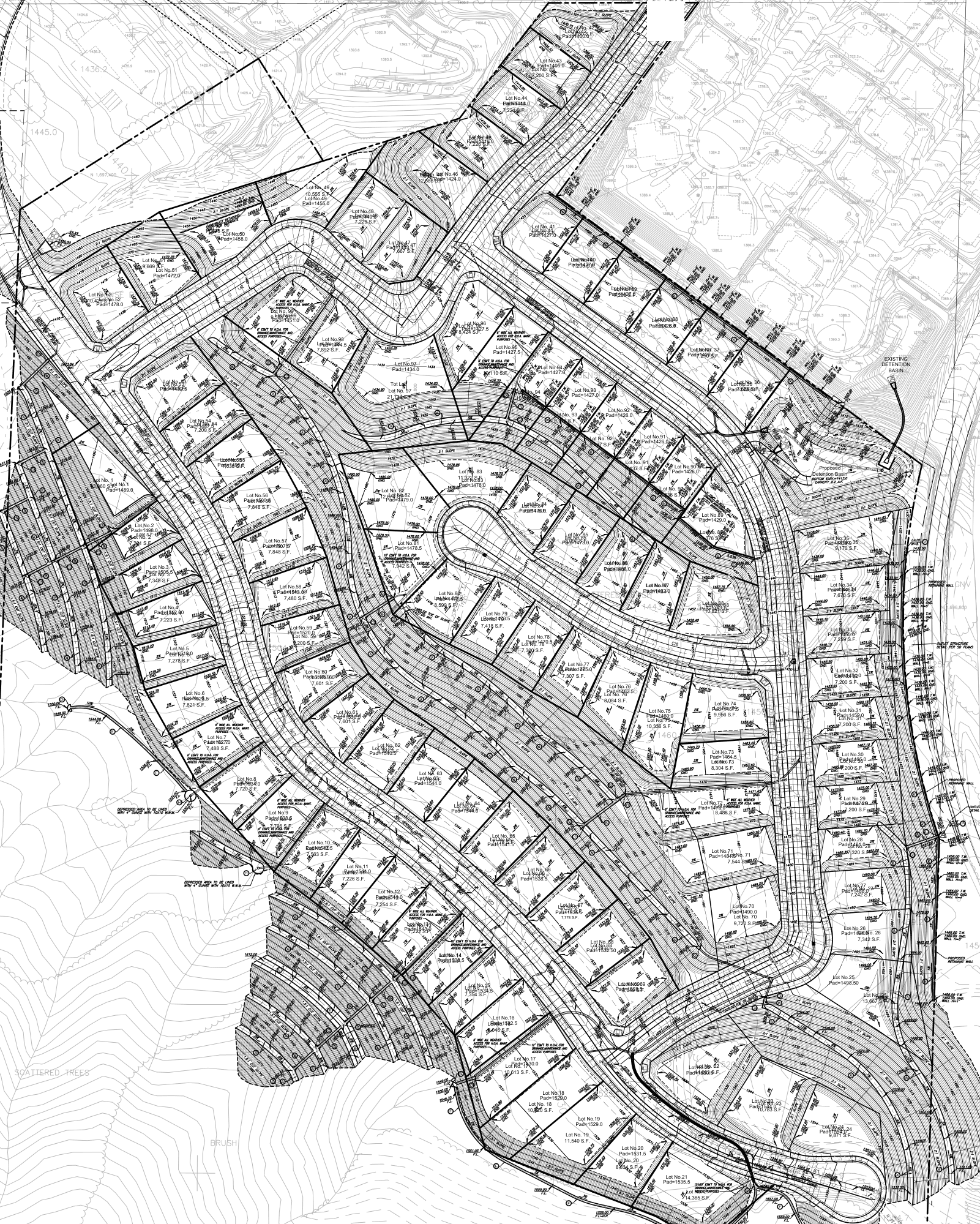
Curvilinear streets wrap the hillside; lots step with the natural grade.
Lots 97, 98 & 99 are HOA common area — clubhouse, pool, courts, and a children's tot lot.
Residential pads sit on roughly half the community; the rest stays protected open space.
Every pad elevation, street, and drainage basin is designed and drawn.
Lot Inventory & Availability
Explore all 99 lots
Tap any parcel for its exact size, tier, and price. Switch 'Color by' to Size tier to see the lot mix. The three teal parcels are HOA amenity lots (97, 98 & 99), leaving 96 single-family home sites.
Hover or tap any lot on the recorded plan for its size, tier, price, and availability.
Lot positions and square footage are approximate and may shift slightly with final engineering and county recordation.
Official 5-Tier Lot Pricing
Enter on raw land — end with a deeded, developed lot
Reserve your place with a low Phase 1 raw-land entry. As the co-op funds civil work, that grows into a fully-developed, utility-served lot titled in your name — debt-free. Build your modular home later; the all-in cost, retail value, and built-in equity are shown for the full picture.
Your first capital call reserves your lot and joins the co-op. Nothing more is due until civil work begins.
Your fully-developed parcel — graded, with water, sewer, power & fiber to the lot — recorded in your name, debt-free. Build your home after.
Standard 2-to-3 module ranch or farmhouse designs with standard setbacks.
- Phase 2 · Civil grid & utilities
- $71,000
- Phase 3 · Final map & deed
- $13,213
Extra driveway depth, larger side yards, or wider single-story footprints.
- Phase 2 · Civil grid & utilities
- $83,500
- Phase 3 · Final map & deed
- $13,213
Spacious family backyards, multi-car detached garages, or wide porches.
- Phase 2 · Civil grid & utilities
- $96,000
- Phase 3 · Final map & deed
- $13,213
Large estate-style footprints or compact detached companion units.
- Phase 2 · Civil grid & utilities
- $106,000
- Phase 3 · Final map & deed
- $13,213
Maximum flexibility — huge custom layouts plus full standalone ADUs.
- Phase 2 · Civil grid & utilities
- $126,000
- Phase 3 · Final map & deed
- $13,213
The lot investment is the projected horizontal (land + infrastructure) cost per member, released across the phased capital calls. Vertical construction is financed separately and estimated at $200/SF. Retail value at completion is estimated at a conservative $375/SF for the finished home; built-in equity is the projected retail value less the all-in cost. All figures are projections and estimates, not guarantees; market values will vary.
Community Parks & Recreation
A private clubhouse & amenity commons
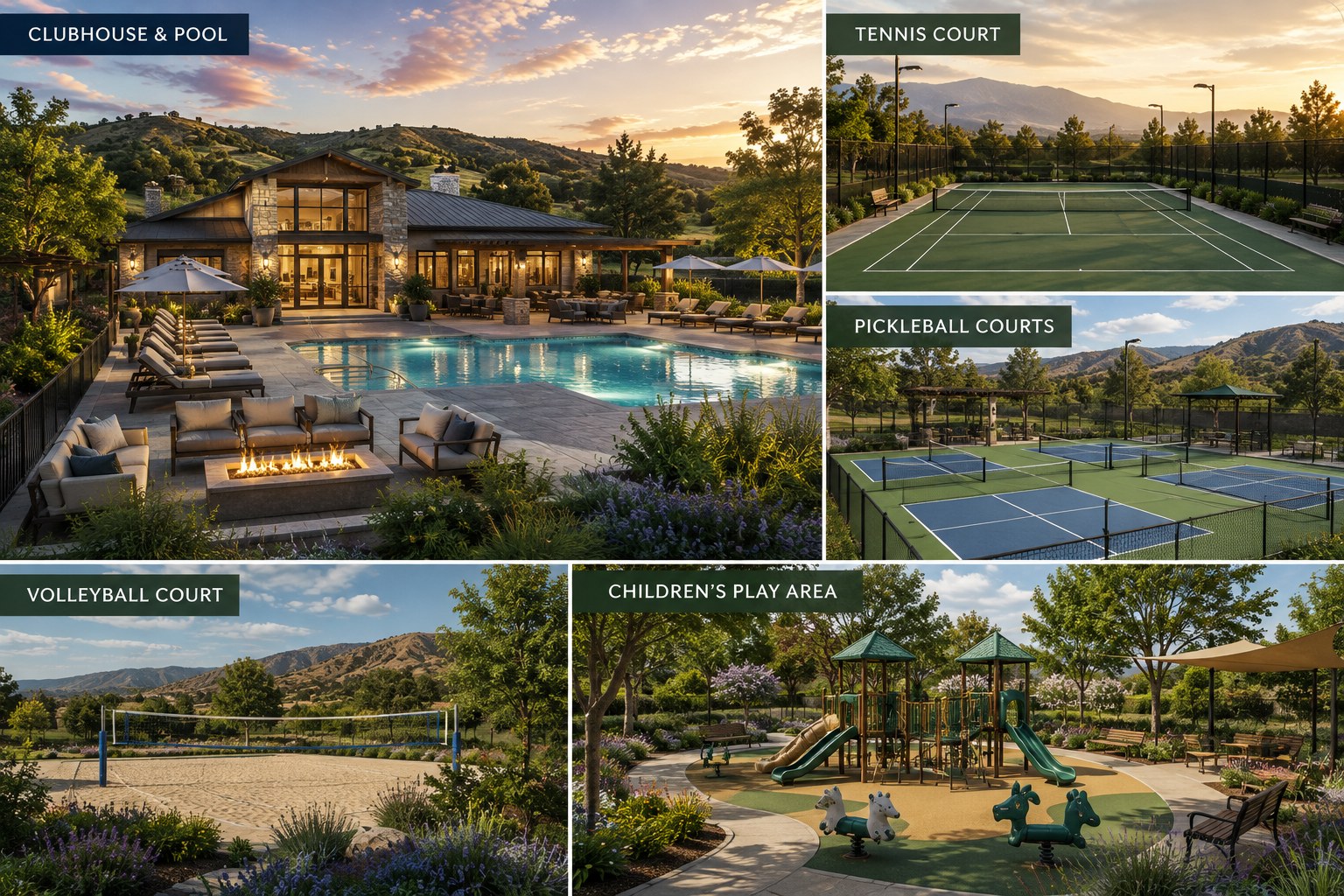
When we designed the Lake Woods cooperative, we did something traditional corporate builders never would: we permanently retired Lots 97, 98, and 99 from residential building and dedicated them entirely to a shared HOA Parks & Recreation Zone. Combining these three parcels creates an expansive 39,210 SF private amenity commons right inside our residential boundary — the community clubhouse, pool, sport courts, and play areas.
- Lots retired
- #97, #98, #99
- HOA dues
- $200/mo
- Residential build
- Never
The neighborhood Tot Lot
A fully equipped, modern play structure for families — shaded by mature trees and secured safely away from the main traffic corridors.
Active recreation areas
A clubhouse, pool, and sport courts alongside clean manicured lawns, walking-path trail loops, and shared barbecue pavilions — built for neighborhood block parties and weekend gatherings.
Eco-friendly stormwater integration
The amenity commons seamlessly integrates with the neighborhood's engineered drainage. Collective HOA ownership keeps the water-filtration basins permanently maintained — protecting homes and nearby open-space landscapes.
A permanent luxury buffer
Because these amenity parcels sit right next to the standard lots, they act as a permanent luxury buffer — no one can ever build a house blocking your views or crowding your street. Upkeep is funded by modest $200/month HOA dues, so the community stays beautiful for decades to come.
Views & Renderings
See the plan — and what's coming
Real crops of the engineered plan today, with space reserved for aerials and renderings as they're produced. Click any image to enlarge.
Why Lake Elsinore
The right market — not just the right project
Southern California's coast is built out and priced out. Lake Elsinore sits squarely in the Inland Empire's growth path — with coastal access, inland pricing, and land you can still build on.
Coastal access, inland price
You reach the Orange County coast in about 30 miles over the Ortega Highway — while buying in at a fraction of coastal and Irvine home prices. That gap is the opportunity.
In the Inland Empire's growth path
Southwest Riverside County is one of Southern California's fastest-growing areas. As buyers are priced out of the coast, they move inland — and demand follows them here.
Land the coast can't offer
Coastal cities are built out; new supply is scarce and expensive. Lake Elsinore still has entitled, developable land — so we build new at cost instead of overpaying for resale.
On every major corridor
The I-15 links Los Angeles and San Diego; the Ortega Highway (SR-74) opens the coast. Commuter-feasible to OC and Inland Empire job centers, with Temecula and San Diego to the south.
A lifestyle destination
Home to Southern California's largest natural lake, year-round outdoor recreation, motorsports, and open space — a genuine destination, not just a bedroom community.
Room to appreciate
As the coast stays unaffordable, value keeps shifting inland. New, amenity-rich communities in the growth path are positioned to capture that upside.
Market outlook reflects our opinion and general conditions — it is not a prediction or guarantee. Real-estate values can fall as well as rise.
Location & Market
Inland value, coastal reach
- Market
- Lake Elsinore, CA
- County
- Riverside County
- Site
- 50% open green space
- Access
- Direct off CA State Route 74
- Region
- SoCal Inland Empire (I-15 corridor)
- 30 miPacific coast & beachesSan Juan Capistrano / Dana Point via the Ortega Hwy
- 40 miIrvine & Orange County job centersCoastal employment & tech hubs
- 20 miTemecula wine countryOld Town & vineyards, south on I-15
- 25 miRiversideCounty seat, north on I-15
- 60 miSan DiegoMetro & airport
- 72 miLos AngelesGreater LA basin
Driving distances are approximate.
Lake Elsinore lifestyle
Minutes from Southern California's largest natural freshwater lake — boating, fishing, wakeboarding, and lakefront trails — in one of the Inland Empire's fastest-growing, still-attainable housing markets. The hillside setting delivers long open views.
The Ortega Highway (SR-74)
Direct frontage on Route 74 — the scenic Ortega Highway over the Santa Ana Mountains — links the community straight to the Orange County coast (30 mi) and Irvine's job centers (40 mi), while I-15 opens Temecula, Riverside, and San Diego. Inland value with coastal reach.
Elite coastal commuting meets affordable luxury
Why sacrifice your financial freedom to live near your career? Lake Woods sits on the premier western commuter border of Southwest Riverside County, positioned directly off the State Route 74 Ortega Highway corridor.
Enjoy a seamless, scenic commute directly into the high-paying corporate, tech, and healthcare employment hubs of South Orange County — including Irvine and Mission Viejo — while enjoying a custom detached home built at direct wholesale cost. We provide the perfect bridge to maximize your coastal career earnings while insulating your family's cost of living.
The 3-Phase Capital Blueprint
Your capital, released against milestones
To protect your capital, funds are not requested all at once. Your total projected horizontal investment is broken into three milestone-driven capital calls — held in a secure third-party construction escrow and released only after an independent civil inspector signs off on each verified engineering milestone. Your initial Land & Launch call scales by lot tier ($39K / $49K / $59K).
Held in third-party construction escrow · released only as an independent inspector signs off on each milestone.
Shown for a base Tier 1 lot. Larger tiers add a one-time size premium — up to $198,213 for a 12k+ estate. See the pricing tiers for exact per-lot figures.
1Land & Launch
$39,000$39K base · $49K Tier 4 · $59K Tier 5The all-cash, debt-free purchase of the multi-million-dollar parcel and project launch: geotechnical soil mapping, environmental Phase I reviews, a state-level Substantial Conformance Review (SCR) to swap pre-approved maps to modern modular footprints, plus final city/county plan-checks, grading-permit submittals, and Caltrans Route 74 access permits.
Safety net: if unexpected site constraints surface during the initial due-diligence window, the project can be dissolved and all remaining unspent capital returned to the group.
2Civil Grid
$71,000$71K–$126K by tierGround breaks on the community's buildable pocket: mass grading, internal street loops, curbs and sidewalks, the stormwater retention basin, and deep water, sewer, and power mainlines run to each lot boundary.
3Final Map & Deed Distribution
$13,213Final utility capacity connections paid; the county records the Final Tract Map and the LLC hands you a clean, unencumbered individual Grant Deed in your personal name or family trust.
Phase 4 · The Vertical Build
From debt-free deed to finished home
Once you hold the debt-free deed to your lot, the project transitions from a pooled-cash model to an individual building model. Choose a pre-approved modern layout from 1,200 – 2,400+ sq ft.
Building a custom house in California from scratch routinely demands a staggering $400–$700 per square foot in local labor and material overhead. Because Lake Woods skips traditional retail brokers and buys 96 homes directly from the high-capacity commercial line at Champion Homes, we unlock a true factory base price averaging just $125 per square foot. Even after adding engineered concrete foundations, heavy crane delivery, and municipal utility hookups, our complete vertical build targets an incredibly affordable $200 per square foot. This co-operative wholesale structure creates a massive equity barrier — keeping your total build cost hundreds of thousands of dollars below traditional retail values from the day we break ground.
Equity as your down payment
Because you own California land free and clear, premier modular-approved lenders will frequently let your built-in lot equity cover your loan down payment.
Debt-free land leverage
Walk into a preferred regional credit union, show your debt-free deed, and secure a standard residential construction loan with $0 out-of-pocket cash — your built-in land equity covers the down payment.
Customization
Choose a pre-approved modern layout (1,200 to 2,400+ sq ft), select interior finishes, and your home is delivered, craned into place, and completed in a fraction of stick-built time.
Investor Safeguards & Compliance
Structured to protect your capital
Escrow-controlled funds
Every capital call is held in a third-party construction escrow account. No dollar releases to a contractor until an independent civil inspector physically signs off on the completed milestone — the graded road, the laid pipe — so money never moves ahead of verified work.
Development transparency
A neutral third-party CPA maintains a line-item budget — updated monthly and viewable by every member on a password-protected 24/7 portal. Contractor bids, draw approvals, and balances stay open-book.
Securities compliance
This private offering is structured strictly under Federal Regulation D exemptions, bound by an institutional-grade Operating Agreement with automatic default-replacement clauses so no single partner's delays can stall the community's progress.
Master FAQ
Everything you need to know
Everything you need to know about our co-operative subdivision project.
Corporate Structure, Legality & Securities
What legally is the Lake Woods Enclave project?+
It is a private real estate co-operative development syndicate. Instead of buying a finished home from a corporate homebuilder at a 30–40% retail markup, we've formed a single Limited Liability Company (LLC). We pool our capital to buy the land parcel, engineer the neighborhood grid at a wholesale price per lot, and install state-approved custom modular homes at direct factory cost.
Am I buying real estate or a share in a company when I wire my Phase 1 funds?+
In Phase 1 and Phase 2 you purchase membership equity shares in the Lake Woods LLC. Because the property is currently one single tract of land, individual lot deeds don't legally exist yet. The LLC buys the land and builds the infrastructure; then, in Phase 3, it records the Final Tract Map with the county, dissolves its shared land holdings, and distributes an individual, unencumbered Grant Deed for your specific lot pad into your personal name or family trust.
Since we're pooling money, does this count as a security? How are we compliant?+
Yes. Because multiple people invest capital into a managed real estate project and rely on the manager to create value, it's legally a private securities offering. It is structured strictly under SEC Regulation D, Rule 506(b); we file formal notices with the SEC and the California DFPI. This limits us to a maximum of 35 unaccredited investors — which is why the initial screening questionnaire is mandatory for everyone joining the group.
What if the developer passes away or becomes incapacitated during the build?+
The LLC Operating Agreement contains an institutional Key-Man / Succession Clause. If the primary developer can't manage the build, a pre-appointed, licensed, third-party commercial construction-management firm instantly steps in as substitute manager to complete the Phase 2 civil grading and Phase 3 map recording. Your capital and project momentum are legally insulated from individual personal risks.
Phase 1 Deposit Breakdown & Justification
Why send exactly $9,000 directly to the LLC account instead of all Phase 1 money into escrow?+
It's a developer structure engineered for speed. Traditional land escrows take 60–90 days to close, but civil engineers, surveyors, and city planning departments don't wait for escrow. The $9,000 operating deposit goes directly into the Lake Woods LLC business account for immediate, non-refundable requirements: civil-engineering design retainers, topographical mapping, city plan-check fees, and mandatory CalFire brush clearance.
Is my remaining Phase 1 escrow balance safe? What if the land deal falls through?+
Your remaining balance ($30,000–$50,000 depending on tier) is wired into a secure, independent corporate escrow account at our designated title company — legally locked and untouchable by the developer or contractors. It can only be released to fulfill the all-cash land acquisition at closing. If engineers or environmental surveyors find a major, unfixable fault during the 60-day due-diligence window, the contract is canceled and 100% of your escrow balance is returned automatically by the title company.
Where is the Developer's 5% Project Management Fee included?+
The 5% Project Management Fee is completely deferred to Phase 2. Not a dollar of profit is taken from your upfront $9,000 LLC operating deposit or your Phase 1 land-escrow wires — 100% of your initial capital secures the land asset and clears permits. The developer earns nothing until the land is owned 100% cash, city grading permits are approved, and machinery breaks ground.
Phase 2 Civil Infrastructure & Escrow Protection
How is my money protected on the large Phase 2 capital calls?+
All Phase 2 capital is held in the central corporate escrow vault and disbursed on a bank-grade Progressive Draw Schedule. Funds are never paid to contractors upfront. On the 25th of each month, a licensed, independent civil-engineering inspector physically audits the job site; escrow only releases cash for work that is 100% completed and passed by the inspector.
What if a contractor tries to put a lien on our land over a billing dispute?+
Before our escrow officer releases any progress check to a utility, grading, or paving contractor, that vendor must sign an official California Conditional Lien Waiver — waiving all rights to ever place a mechanic's lien against our shared property. Our land asset stays clean and unencumbered.
What does the Phase 2 Civil Infrastructure capital pay for?+
It funds the complete transformation of raw land into 96 finished, buildable single-family lot pads. It pays for:
- Mass site grading and dirt balancing to match pre-approved map elevations.
- Paving the entire internal street network (A through F Streets), plus concrete curbs, gutters, and sidewalks.
- Three parallel underground wet-utility mainlines (sewer, water, storm drainage) connected to the city mains at our boundary.
- Undergrounding all dry-utility conduits (electricity, natural gas, high-speed fiber) directly to each lot curb.
Lot Sizing Tiers & the HOA Park Zone
Why do larger lots cost more if the utility mainlines cost the same to lay?+
Running pipes down the street costs the same, but lot pricing is driven by land yield, earthwork scale, and retail valuation. A 12,000+ SF lot consumes the same space as two standard 7,000 SF lots — choosing an oversized lot reduces the project's total lot yield, so you absorb a larger pro-rata share of the land price. Larger lots also require heavy equipment to clear, grade, and balance twice the surface area, raising civil labor and fuel costs.
What are we doing with Lots 97, 98, and 99? Why aren't they sold as houses?+
We've permanently retired Lots 97, 98, and 99 from residential development and dedicated them entirely to our shared HOA Parks & Recreation Zone — a 39,210 SF private amenity commons inside our residential boundary, featuring the community clubhouse, pool, sport courts, playground, and shared barbecue pavilions. (This is separate from the roughly 50% of the community preserved as open green space behind the homes.)
Where do the Size Premium Surcharges from Tiers 2–5 go?+
Every dollar from the Tier 2–5 lot-size premiums flows into the LLC's Central Capital Reserve Fund. It fully funds construction of the private HOA park (playground structures, landscaping, paving) and establishes a cash cushion to insulate the group from unexpected city-fee adjustments or field construction variables.
How are lots assigned among the 96 partners? Can I choose my lot number?+
Lot assignment is governed by a strict Chronological Timestamp Queue. Your position is set solely by the exact minute your signed agreement and Phase 1 capital clear our banking portals. When your number is called, you may select any available lot on the map within your funded tier category.
HOA Management & Long-Term Maintenance
How are our private Clubhouse, Pickleball Courts, and Sports Park maintained long-term?+
To avoid the historic mismanagement and deferred maintenance common to volunteer-run neighborhoods, the Lake Woods HOA uses a professional corporate management structure. Day-to-day neighborhood operations, janitorial upkeep, utility routing, and field repairs are managed directly by Sun River Ventures LLC under an institutional property-management contract.
What do our monthly HOA dues pay for, and how are they collected?+
Your monthly dues are pooled into a secure, dedicated HOA capital account managed via our automated online portal. 100% of these funds are systematically allocated to cover the community's true, hard operating overhead: clubhouse electrical and high-speed commuter fiber internet loops, professional weekly landscaping, sports-court cleaning, trash cleanup, and shared-asset property taxes.
What is the benefit of having the developer manage the HOA instead of the neighbors?+
Traditional volunteer HOAs are notoriously prone to neighbor-to-neighbor favoritism, delayed repairs, and unexpected 'Special Assessment' bill spikes when equipment breaks down. By having Sun River Ventures LLC serve as our permanent, professional management umbrella, we're able to deliver a premium, resort-style experience. Our firm uses commercial-grade software and a rolling, audited reserve fund to absorb maintenance hurdles smoothly. This setup is designed to keep your gym equipment current, your courts immaculate, and your community's long-term appeal strong — without any personal, neighborly drama.
Phase 3, Deeds & Individual Bank Financing
When do I actually get the physical deed to my lot?+
Your individual, unencumbered Grant Deed is distributed at Phase 3 — triggered the moment our civil infrastructure passes final city inspections and Riverside County records our Final Tract Map. Escrow records your ownership, and the lot belongs entirely to you or your family trust, free and clear of debt.
How do I finance the modular home once Phase 3 is complete?+
Because you used pooled cash to buy the land and finish infrastructure, you enter Phase 3 owning a high-value piece of California land 100% debt-free. When you approach a modular-approved bank or credit union for a Residential Construction-to-Permanent Loan, the bank appraises your finished lot and counts its full market value as your down payment — in most cases allowing 100% financing for your modular home with $0 additional out-of-pocket cash.
Why can't I just take a standard home mortgage from Day 1?+
Residential mortgage banks are legally prohibited from issuing individual home loans on unrecorded land tracts. Until our Final Tract Map is recorded at Phase 3, your specific lot doesn't legally exist as an independent asset. Pooling cash upfront across Phase 1 and Phase 2 is the only legal mechanism that unlocks individual lot deeds, parcel numbers, and traditional bank home financing.
Phase 4 Vertical Modular Construction & Logistics
What are the vertical modular building costs, and what do they include?+
Once you hold your deed, you enter an individual building contract to order your custom layout. Factory fabrication and crane installation target a wholesale $150–$250 per square foot in California. This includes complete indoor factory manufacturing (walls, framing, insulation, integrated plumbing, electrical, cabinetry, and finishes), transportation to site, hydraulic crane setting onto your foundation, and final structural tie-ins.
Will all 96 modular homes be delivered and built at the same time?+
No. Modular building is far faster than stick-built framing, but a factory line can't manufacture 96 homes at once, and our streets can't stage 96 cranes at once. Vertical construction runs in four rolling delivery phases of roughly 24 homes each. Your position in the production line is set by a transparent community lottery at the close of Phase 3 map recordation.
Are these built to HUD mobile-home codes or standard building codes?+
Every structure is a Permanent Modular Home built strictly to the California Building Code (CBC) and overseen by the state Department of Housing and Community Development (HCD). These are not mobile homes or manufactured trailers — they're set permanently on concrete foundations, feature full Title 24 solar integration, and comply with Wildland-Urban Interface (WUI) fire-safety rules. As a result they appraise, appreciate, and insure at the same or higher valuations as a traditional stick-built neighborhood.
Exiting, Liquidity & Default Protection
What happens if I face an unexpected life event mid-project and need to exit and liquidate my money?+
Life happens, and Lake Woods is structured to protect both your personal peace of mind and our collective community momentum. Because we are pooling cash, you cannot simply demand a refund from the LLC checking account, as doing so would drain active construction reserves and stall work for the other 95 families. Instead, your exit is managed smoothly through a structured Right of First Refusal (ROFR) process built into our Operating Agreement. You can transfer your position to a vetted buyer on our Project Waiting List, or opt for an LLC corporate buyback using our central capital reserves.
If I buy out a friend who is exiting mid-project, how much do I pay them?+
If you or a buyer from our waiting list steps into an exiting partner's shoes during Phase 1 or Phase 2, the buyout price matches the exact dollar amount the exiting friend has physically funded up to that specific date. For example, if they completed their initial Phase 1 buy-in and paid $20,000 worth of verified Phase 2 progress draws, your buyout wire to them will be exactly what they put in. You then take over their precise lot choice, queue position, and all future capital call responsibilities.
What is the LLC Corporate Buyback Option, and does it carry a penalty?+
If an investor must exit immediately and our Project Waiting List is temporarily empty, the LLC itself holds the right to step in and execute a corporate buyback using our Central Capital Reserve Fund (the surplus cash generated by our Tier 2–5 lot size premiums). To protect the remaining 95 partners from sudden administrative and overhead drains, corporate buybacks feature a 10% to 15% early-exit liquidity penalty. The LLC purchases the shares at this discounted rate, takes back full ownership of that specific lot, and holds it to resell later at full retail market value.
What happens if an investor simply stops paying their Phase 2 infrastructure calls? Can one person stall the whole neighborhood?+
Absolutely not. To protect the group from being held hostage by a single member's financial issues, our LLC agreement features a strict Automatic Default Dilution Clause. If a partner misses a milestone capital call, they are issued a formal 15-day notice to cure. On Day 16, if they fail to fund, their project voting rights are instantly stripped, their lot reservation is canceled, and their existing equity is automatically diluted or forcefully transferred to a backup investor. This legal guardrail keeps our grading tractors and utility crews on schedule, so one member's delay can't stall the build.
What if there is a severe market downturn and my shares can't be bought out by a backup investor or the LLC?+
In an extreme economic scenario where no immediate liquid buyer exists inside the syndicate or the waiting list, an exiting partner's funds remain locked as hard equity until the end of Phase 2. As soon as Phase 3 concludes, the city passes our utility grids and the county records our Final Tract Map. At that exact moment, the LLC automatically hands the exiting partner an individual, unencumbered Grant Deed to their specific lot. They are then completely free to list their raw, fully improved piece of land on the traditional MLS real estate market to recoup their capital from any retail buyer.
Corporate Dual-Entity Structure & Asset Isolation
What is the corporate structure of the Lake Woods project?+
This project utilizes an institutional Dual-Entity Structure to separate day-to-day building operations from investor asset ownership:
- The Management Entity — Sun River Ventures LLC acts strictly as the Lead Developer, Project Manager, and General Contractor. It oversees the engineering teams, site handymen, and city permitting lines.
- The Holding Entity — Lake Woods Fund LLC is a brand-new, single-purpose investment company. This is the distinct fund where your capital is pooled, the community land title is held, and your individual lot deeds are generated.
Why don't we just use Sun River Ventures LLC to buy the land and hold the investor cash?+
Mixing new investors and separate land tracts into an existing company introduces severe cross-collateral and legal risks. Because Sun River Ventures LLC already owns outside land assets, placing the Lake Woods project directly inside it would technically make all 96 new partners co-owners of those outside properties. Furthermore, any external liabilities or past transaction histories tied to Sun River Ventures LLC could bleed over and impact our new subdivision, creating a massive risk of co-mingling.
How does this dual-entity format protect my investment capital?+
This structure creates an ironclad Liability Shield around the neighborhood land asset. If a grading sub-contractor gets into a billing dispute or a construction worker gets injured in the field during Phase 2, any resulting legal claims target the operational side of Sun River Ventures LLC. Because the physical land title and primary cash reserves sit safely inside Lake Woods Fund LLC, our core neighborhood property is completely insulated from being frozen or delayed by external operational lawsuits.
Does this structure make my Phase 4 individual bank loan approval easier?+
Yes, significantly. When you transition to Phase 4 and apply for your individual Residential Construction Loan, bank underwriters and title insurance companies will ruthlessly audit the entity distributing your lot deed. Because Lake Woods Fund LLC is a clean, single-purpose entity with zero prior transaction history, old debts, or outside corporate liabilities, title insurance clears instantly. This eliminates the bureaucratic red tape that standard developers face, unlocking your bank financing effortlessly.
How does Sun River Ventures LLC bill the Lake Woods project fund?+
All financial interactions between the two entities are governed by a formal, legal Development Management Agreement (DMA). Sun River Ventures LLC receives the upfront $9,000 operational deposits to pay for fast-moving pre-construction elements (city plan-check counters, immediate handymen, and mandatory CalFire brush mowing). It is also the entity that collects the 5% Project Management Fee during Phase 2 progressive escrow draws, ensuring all overhead billing is completely transparent and categorized by our neutral accounting firm.
Still have questions? Positions fill by funding timestamp.
Register Your InterestLot Selection
First to fund, first to choose
Lot selection priority is set by one thing only: the timestamp your Phase 1 deposit reaches the escrow account. The earliest members lock in the estate lots and the view lots bordering the open green space. It's a simple, fair, first-come queue — so the premium spots go fast.
Register Your InterestGet involved
Register Your Interest
Register your interest and we'll be in touch about Lake Woods — the plan, tiers, pricing, and how to join the co-operative.
For questions, contact Pavan Sunkara · (480) 427-6373